No products in the cart.
Return To Shop




 0
0 No products in the cart.
Return To ShopWalk into any watch shop in Nairobi, from the stalls along Moi Avenue to the glass counters at Sarit Centre, and you’ll notice the same two names keep coming up: Casio and G-Shock. There’s a reason for that. These aren’t the flashiest watches on the shelf, but they’re the ones people are still wearing five years later. If you’re trying to work out which watch deserves a spot on your wrist, or you’re shopping for someone else and don’t want to gamble on a brand you’ve never heard of, this guide walks through what actually matters: durability, authenticity, price, and fit for your lifestyle. We’ll also point you toward our more detailed guides on men’s Casio, women’s Casio, and G-Shock pricing, depending on what you’re after.
Ask around and you’ll hear the same three reasons over and over: durability, name recognition, and resale value.
Casio watches are built to survive daily wear without much fuss. Drop one, get caught in the rain, forget you’re wearing it in the shower — most Casio models shrug that off. That matters in a city like Nairobi, where a watch needs to keep up with matatu rides, construction sites, hospital shifts, and everything in between.
Name recognition counts for more than people admit. When you’re buying a gift, or replacing a watch that got lost, there’s comfort in choosing a brand your uncle, your boss, and your barber have all owned at some point. Casio has been sold in Kenya for decades, and the parts, straps, and batteries are easy to find almost anywhere.
Then there’s resale value. A genuine Casio holds its value far better than an unbranded watch at a similar price, simply because buyers know what they’re getting. Second-hand Casio and G-Shock watches tend to move quickly on local marketplaces, which isn’t something you can say about most budget watches.
G-Shock takes the same reliability and pushes it further — genuine shock resistance, water resistance rated for actual use rather than just a shower, and a design language that’s become recognisable on its own. It costs more than a standard Casio, but for buyers who need a watch that can take a beating, the difference is usually worth paying.
There’s no single “best” watch, because the answer depends entirely on who’s wearing it.
If you’re buying for everyday wear — checking the time between meetings, catching a matatu, running errands — you probably want something light, easy to read, and not too precious to wear daily. A classic Casio digital does that job without complaint.
If the watch is a gift, particularly for a graduation, promotion, or birthday, presentation matters more. A boxed Casio or G-Shock with a warranty card feels considered in a way a random market-stall watch doesn’t, even when the price difference is small.
For sport or rugged use — hiking, gym sessions, boda boda commutes, fieldwork — you want something that can handle knocks and sweat without the display cracking or the strap perishing. This is where G-Shock earns its reputation; it was designed from the outset to survive drops that would kill a normal watch.
Office wear calls for something a notch smarter. An analogue-digital hybrid or a slim analogue Casio reads as more professional than a sports watch, while still being far more affordable than a dress watch from a luxury brand.
Knowing which of these you’re shopping for narrows the decision considerably, and it’s the first question worth asking before you look at a single model.
Digital watches show the time as numbers on a screen. They’re usually the cheapest option, the easiest to read in the dark thanks to backlighting, and they often pack in extras like a stopwatch, alarm, and world time. If you want maximum function for your money, this is where to look.
Analogue watches use the traditional hour and minute hands. They tend to look more formal, which makes them a better fit for the office or for gifting to someone older. The trade-off is fewer built-in features — you’re paying for the classic look rather than the functionality.
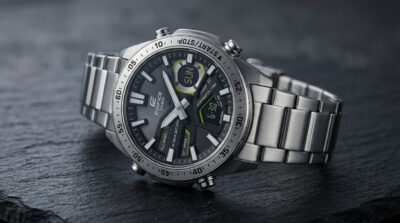
Analogue-digital hybrids try to give you both: hands for the main time display, plus a small digital window for the date, a second time zone, or a stopwatch. Chronograph-style Casio watches, with extra sub-dials on the face, fall into this category too, and are especially popular with men who want a watch that looks a bit more serious without the digital-watch look.
None of these is objectively “better” — it comes down to what you’ll actually use and where you’ll wear it. Someone commuting and training in the same watch usually leans digital or hybrid. Someone wearing a watch mostly at a desk usually leans analogue.
Counterfeit and grey-market Casio watches are common enough in Kenya that it’s worth knowing what to check before you buy.
Start with the dial printing. On a genuine Casio, the logo, text, and any sub-dial markings are sharp and evenly spaced, with no smudging or uneven ink. Fakes often have slightly blurred printing or text sitting just off-centre.
Check the module number on the back of the case — a short code stamped into the metal. You can look this up against Casio’s official watch catalogue to confirm it matches a genuine model, rather than a case shape borrowed from somewhere else.
Packaging and paperwork matter too. A genuine Casio bought through an authorised retailer comes with a proper box, an instruction booklet, and a warranty card that names the seller. If a “brand new” watch arrives in a plastic bag with no documentation, that’s a red flag regardless of how good the price looks.
Buying from a retailer that guarantees authenticity, rather than an unverified stall or an unfamiliar online seller, removes most of this risk from the start — which is really the simplest solution if you’d rather not play detective.
Prices shift often enough that quoting exact figures here would be out of date within months, but the general shape of the market is worth knowing.
Basic digital Casio watches sit at the affordable end, making them a sensible starting point if budget is tight or you’re buying more than one as gifts. Analogue-digital and chronograph-style watches cost more, reflecting the extra components and more detailed dial work. G-Shock sits above standard Casio across the board, with the gap widening for models that add features like solar charging, Bluetooth connectivity, or a metal case.
Rather than fixating on a number, it’s more useful to decide your ceiling first and then see what falls within it — a solid digital Casio and an entry-level G-Shock can end up closer in price than people expect, especially during sale periods.
August tends to be a busy stretch for graduations and promotions across Kenya, and a watch remains one of the more sensible gifts for the occasion — practical enough to actually get used, but still feels like an event gift rather than something grabbed at the last minute.
A Casio or G-Shock works particularly well here because it doesn’t assume much about the recipient’s taste. A classic analogue-digital model reads as appropriate for a graduate stepping into office life, while a G-Shock suits someone heading into a more physical or outdoor career. Either way, the brand recognition does some of the work for you, even when you’re not entirely sure what the person would have picked for themselves.
Both routes work, but they solve slightly different problems. Buying in person lets you actually try the watch on, which matters more than photos suggest — a case that looks reasonably sized online can feel oversized or fiddly once it’s on your wrist, and strap comfort is impossible to judge from a product page. It also means you can inspect the dial printing and build quality yourself before handing over cash.
Buying online tends to win on convenience and comparison. You can look at several models side by side, check specifications properly, and avoid the pressure that sometimes comes with an in-person sales pitch. The trade-off is trust: it only works well if the retailer is transparent about authenticity, has clear return terms, and actually delivers what’s shown on the page. That’s less of a risk with an established local retailer than with an unfamiliar overseas seller shipping into Kenya, where returns and warranty claims become far more complicated if something goes wrong.
A reasonable middle ground, if you’re unsure, is to browse and shortlist online, then either collect in person or ask the retailer specific questions before committing — module number, warranty terms, what’s included in the box. A retailer confident in what they’re selling will answer all three without hesitation.
Part of why Casio has such a strong reputation is that owners rarely need to think about maintenance, but a little care still extends the life of a watch noticeably. Rinsing a watch with fresh water after exposure to seawater or sweat prevents the case and strap from corroding or perishing early. Avoiding extreme temperature swings — leaving a watch on a dashboard in direct sun, for instance — helps the internal components and any adhesive seals last longer. Resin straps eventually stiffen and crack after years of UV exposure, which is normal and simply means it’s time for a replacement rather than a sign anything is wrong with the watch itself. None of this is high-maintenance by any stretch; it’s closer to common sense than a real routine.
Every Casio and G-Shock sold through Top Time Shop is genuine, sourced through proper channels rather than parallel imports of uncertain origin. Each watch comes with its full packaging, documentation, and a warranty that actually means something if a fault turns up. Full details on cover and returns are on our warranty and shipping page.
If you’re buying for yourself, that’s peace of mind. If you’re buying as a gift, it’s the difference between handing someone a watch and handing someone a watch you’re confident will still be working in three years.
For a closer look at specific picks, see our guides to Casio watches for men, Casio watches for women, and our G-Shock price guide for a full model breakdown.
Are Casio watches sold in Kenya genuine?
Not always, unfortunately — grey-market and counterfeit units do circulate. Buying from an authorised retailer with proper documentation is the safest way to guarantee you’re getting the real thing.
What’s the difference between Casio and G-Shock?
G-Shock is a Casio sub-brand built specifically for shock and water resistance, aimed at buyers who need a watch that can survive drops, sport, and rough daily use. Standard Casio watches are more general-purpose.
How long does a Casio watch battery last?
Most standard Casio digital and analogue-digital models run for around two years on a single battery, though solar-powered G-Shock models can go far longer between servicing.
Is a digital or analogue watch better for everyday use?
It depends on the wearer — digital suits people who want extra features like alarms and a stopwatch, while analogue suits people who prefer a more classic, formal look.
Do Casio watches come with a warranty in Kenya?
Genuine Casio watches bought through an authorised seller such as Top Time Shop come with a manufacturer warranty and full documentation.
No account yet?
Create an Account